Cathedral of St. Andrew the First-Called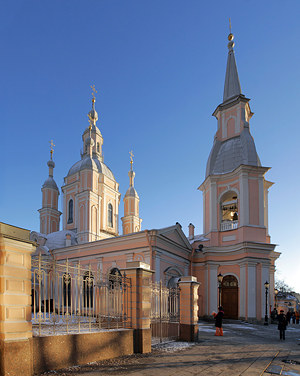 named after the Apostle Andrew, whom Peter the Great considered his personal protector, and who thus became
patron saint of Imperial Russia and of the Russian Navy, this beautiful, late baroque, pink-and-white cathedral
stands on the corner of Bolshoy Prospekt and 6-aya Linia, in a particularly picturesque part of Vasilevsky Island.
named after the Apostle Andrew, whom Peter the Great considered his personal protector, and who thus became
patron saint of Imperial Russia and of the Russian Navy, this beautiful, late baroque, pink-and-white cathedral
stands on the corner of Bolshoy Prospekt and 6-aya Linia, in a particularly picturesque part of Vasilevsky Island.
Peter himself ordered the building of the original Church of St. Andrew on this site, and plans and models for
the church has already been chosen when the Emperor died. In 1732, under Empress Anna Ioannovna, a single-storey
wooden
church was built there. This church was struck by lightening in 1761, and burned to the ground. Alexander Vist,
architect of the Senate Building, was commissioned to design a new stone cathedral but, after two years of
construction work, one of the arches supporting the building's main dome collapsed, and Vist was dismissed.
The job of finishing the cathedral was entrusted to Alexei Ivanov, a professor at the Academy of Arts.
The cathedral, a late baroque masterpiece, similar in design to the St. Nicholas Naval Cathedral,
was eventually consecrated in 1781.
In the 19th century, two chapels were added to the Cathedral by architect Nikolai Grebenka. The Cathedral of
St. Andrew was closed after the Revolution, and given over to various organizations, including the Institute
of Ethnography. During the Siege of Leningrad, the Cathedral was severely damaged both by bombs and by shelling.
Thanks to the sharp thinking of members of the cathedral's congregation, the famous iconostasis, which had
originally stood in the chapel of the Menshikov Palace nearby, was partly saved from the ravages of war and
revolution, carefully hidden behind false paneling. Since being returned to the Orthodox Church, the Cathedral
has been fully restored, and pride of place inside is given to several 18th century icons, including two - one
painted, one mosaic - of St. Andrew.
 Next
Next